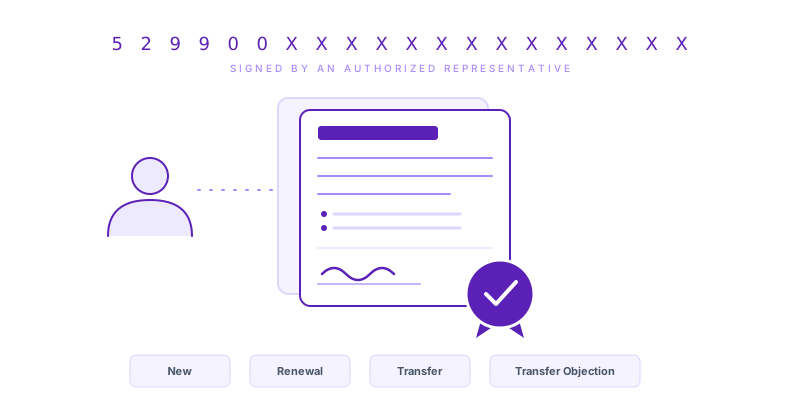
What is a Letter of Authority?
A Letter of Authority (LoA) is a short signed statement confirming that the person submitting an LEI application — or acting on an existing LEI's renewal or transfer — is authorized to represent the legal entity in question. TheLEICorp, as US Registration Agent for Ubisecure RapidLEI, requires an LoA whenever the applicant isn't already established as the entity's authorized contact on file.
A related document, the Transfer Objection, lets a current LEI holder object if another party initiates a transfer of their LEI away from Ubisecure RapidLEI without their knowledge. Both document types must be signed by an individual with the authority to represent the entity — typically an officer, director, partner, or authorized manager.
When do I need a Letter of Authority?
- New registration — if you're applying for a first-time LEI on behalf of a legal entity you're not already listed as the authorized contact for.
- Renewal — if you're renewing an existing LEI managed through TheLEICorp on behalf of the entity, and you weren't the original applicant.
- Transfer — if you're moving an existing LEI to TheLEICorp from a different LEI Issuer or Registration Agent.
- Transfer objection — if you currently hold an LEI through TheLEICorp and want to object to a transfer request initiated by another party.
If you're the entity's own authorized contact submitting your own application, an LoA usually isn't required — see the application process guide for the standard workflow.
Download the templates
Download the template that matches your scenario, complete it, and have it signed by someone with authority to represent the entity. Templates are provided as editable Word documents.
| Purpose | Usage | Document |
|---|---|---|
| Letter of Authority — New | First-time LEI registration submitted on behalf of an entity | Download |
| Letter of Authority — Renewal | Renewing an existing LEI managed by TheLEICorp | Download |
| Letter of Authority — Transfer | Transferring an LEI to TheLEICorp from a different issuer | Download |
| Transfer Objection | Objecting to a transfer request initiated by another party | Download |
How to submit your document
- Download and complete the template. Fill in the legal entity name, LEI (for renewals and transfers), and the other requested details.
- Get it signed. The signatory must have the authority to represent the entity. We may request supporting evidence of that authority.
- Send it with your application. Attach the signed document when you submit your request via the contact form, or reply to your application confirmation email with it attached.
Frequently asked questions
Who can sign a Letter of Authority?
Anyone with the authority to represent the legal entity — typically an officer, director, partner, or authorized manager. We may ask for supporting evidence (such as a corporate resolution or registry filing) if the signatory's authority isn't otherwise clear from our records.
Does the Letter of Authority need to be notarized?
No. A notarized signature isn't required for standard applications. In rare cases involving a disputed transfer or objection, we may request additional verification before proceeding.
What if I'm not sure whether I need one?
If you're submitting on behalf of an entity and you're unsure whether an LoA is required for your situation, contact us before you apply and we'll confirm what's needed.
Can I object to a transfer of my own LEI?
Yes. If you hold an LEI through TheLEICorp and learn that another party has requested a transfer away from RapidLEI without your knowledge, submit the Transfer Objection template above. We'll place the transfer on hold pending direct confirmation with you.
Related guides
The LEI Application Process
What happens after you submit an application, step by step.
Read the guide →
RegulationsUS LEI Requirements
Which US regulations reference the LEI today, and what happens if it lapses.
Read the guide →
Get started
Have a document ready, or need help figuring out which one applies? Contact us and we'll walk you through it.