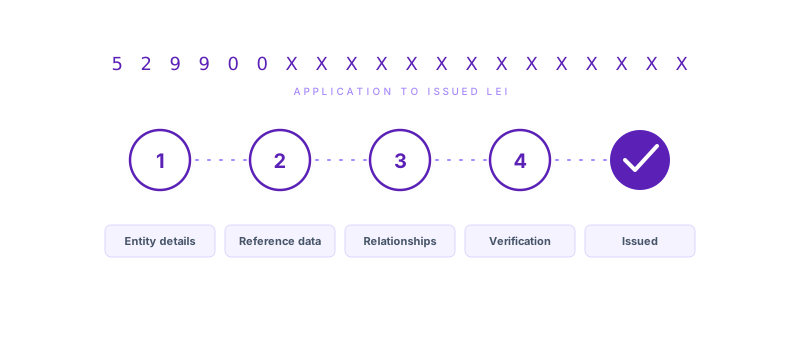
What to expect in the LEI application
Because of RapidLEI's automated verification against official business registries, many LEIs are issued within one business day, though exact timing depends on jurisdiction and how complete the submitted information is. The application generally involves two stages:
- Submission of legal entity, fund, or trust details
- Verification and issuance
The five steps below break both stages down in detail.
Step 1: Submit your entity details
To begin, provide your entity's basic information through our contact form:
- Legal name, country of registration, and registered address
- Entity type — corporation, LLC, fund, or trust
- An authorized contact who can confirm the application on the entity's behalf
- Your preferred LEI term: 1, 3, or 5 years (multi-year plans include auto-renewal)
Where possible, we pre-fill registry data from official business registries to reduce manual entry. If you already hold an LEI with another issuer, choose Renew and provide the existing LEI number instead — see renewals and transfers below.
If you're submitting on behalf of an entity you're not already listed as the authorized contact for, we'll need a signed Letter of Authority — see verification documents for templates.
Step 2: Confirm your reference data
Once your basic details are in, we ask you to confirm or correct the entity's Legal Entity Reference Data (LE-RD) — the official record that will be published against your LEI. This includes the legal name, registered address, and registry identifiers on file with your jurisdiction's business registry.
Accuracy here matters: this is the data that regulators and counterparties see when they look up your LEI, and mismatches against the registry are the most common cause of delayed issuance.
Step 3: Provide relationship data (if applicable)
If your entity is part of a corporate group, fund complex, or ownership structure, you may need to supply additional relationship data — parent entities, ownership percentages, or fund/trust relationships. This supports what GLEIF calls Level 2 reference data, which describes corporate relationships, alongside the Level 1 data (who is who) collected in Step 2.
Not every entity has relationship data to report. Standalone entities with no parent or subsidiary relationships can skip straight to verification.
Step 4: Verification
After submission, we and Ubisecure RapidLEI verify the information provided:
- Automated checks against official business registries
- Manual review where registry data isn't accessible electronically or needs confirmation
Verification confirms that the entity exists and that all reference data matches global LEI standards (ISO 17442) before anything is published.
Step 5: Issuance and publication
Once verified:
- Your LEI code is issued
- The record is published to the Global LEI Index and becomes publicly searchable on search.gleif.org
- You receive email confirmation with your LEI code
Most applications are issued within one business day of successful verification, though timing can vary by jurisdiction and entity type. If you have questions about an in-progress application, contact support.
Renewals & transfers follow the same process
TheLEICorp offers three LEI services: Issuance (first-time registration), Renewal (annual re-validation), and Transfer (moving an existing LEI to Ubisecure RapidLEI). Renewal and Transfer share the same reference-data confirmation and verification steps described above — you're re-entering Step 2 rather than Step 1.
Multi-year plans (3-year or 5-year) automate the renewal step entirely, so the application process only happens once for the life of the plan. See what happens if an LEI lapses for why staying current matters.
Pricing
1 Year
New registration or renewal
- GLEIF fee included
- Entity verification
- Published to global LEI database
- Expert support
3 Years
$199 total
- GLEIF fee included
- Entity verification
- Auto-renewal for 3 years
- Lapse protection
- Expert support
5 Years
$299 total
- GLEIF fee included
- Entity verification
- Auto-renewal for 5 years
- Lapse protection
- Priority support
Frequently asked questions
How long does the LEI application take?
Most applications are issued within one business day once verification is complete, assuming the submitted information matches the official business registry. Entities in jurisdictions with less accessible registry data, or those needing manual review, can take longer.
What information do I need to apply?
At minimum: your entity's legal name, country of registration, registered address, entity type, and an authorized contact. Entities that are part of a corporate group, fund complex, or ownership structure should also be ready to provide parent-entity or relationship details in Step 3.
What is Level 1 vs. Level 2 reference data?
Level 1 data answers “who is who” — the legal name, address, and registration details captured in Step 2. Level 2 data answers “who owns whom” — parent and subsidiary relationships captured in Step 3, where applicable and available.
What if my reference data doesn't match the business registry?
Verification in Step 4 checks your submitted details against the official registry for your entity's jurisdiction. Mismatches — a changed address, a name change, or an outdated registry filing — are the most common reason an application needs manual review. We'll reach out if anything needs correcting before issuance.
Can I check the status of my application?
Yes. Contact support with your entity name or reference number and we'll confirm where your application stands.
Related guides
US LEI Requirements
Which US regulations reference the LEI today, and what happens if it lapses.
Read the guide →
DocumentsLEI Verification Documents
Letter of Authority templates for registrations, renewals, and transfers.
Read the guide →
Get started
Whether you're registering a single entity, a fund family, or transferring an existing LEI, we're ready to help. See pricing above or contact us for volume questions.