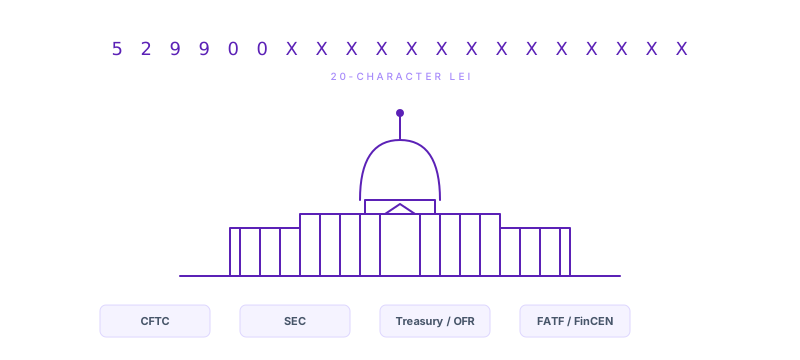
What is an LEI?
A Legal Entity Identifier (LEI) is a 20-character alphanumeric code that uniquely identifies a legal entity participating in financial transactions. The format is defined by ISO 17442 and the system is governed by the Global Legal Entity Identifier Foundation (GLEIF), a not-for-profit established in 2014 by the Financial Stability Board at the request of the G20 after the 2008 financial crisis.
LEIs are issued by accredited Local Operating Units (LOUs), also referred to as LEI Issuers. TheLEICorp is the official US Registration Agent of Ubisecure RapidLEI, an accredited LEI Issuer; we handle the US-facing ordering, billing, and support, and Ubisecure issues the record into the Global LEI Index.
US regulations that reference the LEI
The table below summarizes the principal US regulations that reference the LEI as an entity identifier today. Subsequent sections expand on the highest-volume ones.
| Agency / framework | Affected entities | LEI requirement |
|---|---|---|
| CFTC — 17 CFR Part 45 | Swap dealers, major swap participants, and counterparties to reportable swaps | LEI required for every counterparty to a reportable swap; best-efforts rule for the counterparty's LEI. |
| SEC — Regulation S-K & EDGAR | Public companies, securitization sponsors, certain issuers | LEI referenced in EDGAR filer data and Reg S-K disclosures; lapsed LEIs surface as data-quality flags on filings. |
| SEC — Form PF (amended) | Investment advisers with >$150M in private fund assets under management | Per-fund LEI required on Form PF. Amended-rule compliance deadline: October 1, 2026. |
| FDIC — QFC Recordkeeping Rule | Covered insured depository institutions and their counterparties | LEI required in Qualified Financial Contract recordkeeping submissions to support resolution planning. |
| FATF Recommendation 16 | Banks and payment service providers handling cross-border wire transfers | LEI is the preferred originator/beneficiary identifier in ISO 20022 messaging; national implementation required by 2030. |
| Financial Data Transparency Act (FDTA) | Entities reporting to covered US financial regulators | Mandates consistent, machine-readable data standards across nine US financial regulators; agencies are adopting the LEI as the entity identifier in joint rulemakings. |
CFTC swap reporting (17 CFR Part 45)
The CFTC's swap data reporting rule is the most mature US LEI mandate. Under Part 45, every counterparty to a reportable swap must be identified by an LEI, and that LEI must be reported to a registered swap data repository (SDR) as part of the trade record.
Section 45.6 sets out the “best efforts” rule for the counterparty side: if a reporting counterparty cannot obtain its counterparty's LEI directly, it must take reasonable steps to do so before falling back to alternative identifiers. In practice that means active LEIs are expected for both sides of nearly every CFTC-reportable swap.
When an LEI lapses, the SDR treats the trade record as referencing an invalid identifier. Reporting counterparties typically receive a rejection or data-quality notice and must remediate by renewing the LEI before the record can be accepted. For active swap counterparties, lapse means immediate operational friction.
Asset managers & Form PF
Form PF is the SEC and CFTC's joint reporting form for private fund advisers. The 2024 amendments expand both the scope of reportable information and the granularity at which funds are identified. The LEI plays a central role: an investment adviser with more than $150 million in private fund assets under management is required to report an LEI for each reporting fund.
The amended-rule compliance deadline is October 1, 2026. Advisers that have historically registered an LEI only at the adviser level need to plan ahead — each reporting fund (and, in many structures, each underlying SPV) needs its own LEI, and the registration process needs to be coordinated with each entity's legal formation records.
For fund administrators and law firms acting on behalf of advisers, this is also where most of the volume sits. We work with corporate service providers regularly on per-fund registrations with consolidated billing.
Banks & payments — FATF R16 and ISO 20022
The Financial Action Task Force's Recommendation 16 governs how originator and beneficiary information travels with cross-border wire transfers. The 2025 update to R16 explicitly endorses the LEI as the preferred legal-entity identifier in those payment messages, aligning the anti-money-laundering data standard with ISO 20022, the messaging standard that SWIFT and the US Federal Reserve's FedNow service are converging on.
Implementation timelines vary by jurisdiction; FATF expects national implementation by 2030, but correspondent banking practice is moving faster. Major US banks and payment service providers are already populating LEI fields in ISO 20022 messages and validating them against the public GLEIF index. A lapsed LEI on the originator or beneficiary side can produce a held payment at the correspondent.
What happens when your LEI lapses
LEIs must be renewed annually. The validation cycle includes reverifying the entity against the relevant business registry and reconfirming the reference data published to the Global LEI Index. If the renewal isn't completed by the next-renewal date, the LEI status changes from Issued to Lapsed. The LEI continues to exist — it's still a valid identifier — but the reference data is no longer treated as current.
Across US regulatory and counterparty workflows, that distinction matters:
- CFTC swap reports: SDRs may flag or reject swap records referencing a lapsed counterparty LEI; remediation requires re-renewal and resubmission.
- SEC filings: EDGAR surfaces data-quality flags against lapsed LEIs; certain Form PF and securitization filings will not validate against a lapsed entity reference.
- Cross-border payments: Correspondent banks that validate ISO 20022 LEI fields against the GLEIF index can hold or return wires referencing a lapsed party.
- Counterparty diligence: Buy-side and broker-dealer onboarding tools frequently treat a lapsed LEI as a soft fail, requiring manual remediation.
Multi-year LEI plans — like our 3-year and 5-year auto-renew packages — remove the annual renewal step entirely and eliminate lapse risk for the duration of the plan.
How to register an LEI through TheLEICorp
TheLEICorp offers three LEI services: Issuance (first-time registration), Renewal (annual re-validation), and Transfer (moving an existing LEI to Ubisecure RapidLEI). Renewal and Transfer share a combined workflow.
The process is the same for new registrations, renewals, and transfers:
- Submit your details. Legal entity name, registration jurisdiction and registry ID, headquarters and legal address, and the authorized contact who can confirm the application.
- We validate & register. We verify the entity against the relevant business registry and submit the application to Ubisecure, the GLEIF-accredited LOU. Most validations complete within one business day.
- Receive your LEI. The record is published to the Global LEI Index and immediately searchable on search.gleif.org. You receive the LEI and the confirmation by email.
See the full LEI application process for a detailed walkthrough of reference data, verification, and issuance.
Pricing
1 Year
New registration or renewal
- GLEIF fee included
- Entity verification
- Published to global LEI database
- Expert support
3 Years
$199 total
- GLEIF fee included
- Entity verification
- Auto-renewal for 3 years
- Lapse protection
- Expert support
5 Years
$299 total
- GLEIF fee included
- Entity verification
- Auto-renewal for 5 years
- Lapse protection
- Priority support
Frequently asked questions
What is the difference between an LEI and an EIN?
An EIN — the Employer Identification Number issued by the US Internal Revenue Service — is a federal tax identifier. It's used by the IRS to track employer, income, and information-return filings, and is scoped to the US tax system.
An LEI is a global entity identifier under the ISO 17442 standard, issued through the GLEIF system for use in financial reporting and transactions. It travels with the entity across borders and counterparties, and is referenced by regulators such as the CFTC, SEC, FDIC, and FATF.
The two identifiers serve different purposes and do not substitute for each other. Most US entities that file with the SEC or CFTC end up needing both: an EIN for tax administration and an LEI for financial-market reporting.
Can I use the same LEI for SEC, CFTC, and FATF reporting?
Yes. The LEI is a single global identifier, and the same code is valid across every regulator that references it. You don't need a separate LEI per regime. What does need to be maintained is the LEI's status: an active, validly-renewed LEI is honored across all the regulatory frameworks listed above; a lapsed one is treated as a data-quality issue by each of them.
Do I need a separate LEI for each fund, trust, or SPV I manage?
Generally yes. Each distinct legal entity that is a reporting counterparty — or, under Form PF, a reporting fund — needs its own LEI. Asset managers with multiple funds typically register an LEI per fund. The same principle applies to securitization SPVs, master feeders, and umbrella structures where the constituent entities have independent legal personality.
For corporate service providers and fund administrators handling these registrations in bulk, we offer consolidated billing and a single point of contact — reach out via the contact form.
Can I transfer an existing LEI from another issuer to TheLEICorp?
Yes. Under GLEIF rules, LEIs are portable between accredited LOUs at no additional cost. If you currently hold an LEI through a different issuer or registration agent, you can transfer it to Ubisecure (via TheLEICorp) by selecting “Renew” on our form and providing your existing LEI. We handle the transfer process with your current managing agent.
Is TheLEICorp accredited by GLEIF?
TheLEICorp is a Registration Agent, not an LEI Issuer. We are the official US Registration Agent of Ubisecure RapidLEI, a Local Operating Unit of GLEIF that issues every LEI we sell. All records are published directly to the Global LEI Index. See Ubisecure’s GLEIF record for the accredited-LOU listing.
Related guides
The LEI Application Process
What happens after you submit an application, step by step.
Read the guide →
DocumentsLEI Verification Documents
Letter of Authority templates for registrations, renewals, and transfers.
Read the guide →
Get started
Whether you need a single LEI for a new entity, a bulk registration for a fund family, or a transfer from another issuer, we'd be glad to help. See pricing above or contact us for volume questions.